Best Rocks for Drainage: What Actually Works Underground
The best rocks for drainage are angular and sized 3/4 to 1.5 inches. Learn which materials work for French drains, dry wells, and foundation drainage.
Quick Answer
The best rock for drainage is angular crushed stone in the 3/4 to 1.5 inch range — specifically washed crushed granite, limestone, or basalt. Avoid round rocks like pea gravel and river rock for drainage applications; their smooth surfaces compact over time, reducing water flow.
Why Rock Shape Matters More Than Rock Type
The single most important factor in drainage rock performance isn't what it's made of — it's its shape. Angular rocks with rough, irregular faces create stable void spaces between stones that remain open over time. Round rocks shift, compact, and gradually fill those voids.
Think of it this way: if you pour marbles (round) into a jar vs. pour crumpled foil balls (irregular) into the same jar, the foil balls leave more air space even if both fill the jar to the same volume. That air space is where water flows. Compact it, and you lose the drainage function.
For French drains, dry wells, foundation drainage, and any application where water movement underground is the goal — angular, washed crushed stone is the correct material.
Best Rock Types for Drainage (Ranked)
1. Washed Crushed Granite — Best Overall
Crushed granite in the #57 size (3/4–1 inch nominal) or #67 size (3/4 inch) is the most widely recommended drainage rock in the U.S. It's angular, widely available, and reasonably priced ($45–$70/ton bulk). "Washed" means the fine particles (dust and debris) have been removed, which is critical — fines fill void spaces and reduce drainage rate dramatically.
Bulk density: ~95 lbs/cu ft (1.28 tons/cu yd). For drain calculations, use our estimator and select Crushed Granite.
2. Washed Crushed Limestone — Budget Choice
Limestone #57 or #67 performs nearly identically to crushed granite for drainage purposes and costs slightly less ($40–$65/ton). The main downside: in areas with acidic soil, limestone slowly dissolves over years, changing the soil pH around plantings. For pure drainage (no nearby plants), it's an excellent choice.
3. River Gravel #57 (Rounded, 3/4 inch)
This is where round rock becomes acceptable for drainage — when the gravel is uniformly 3/4 inch in size and used in a French drain with proper geotextile wrapping. Uniformly sized round gravel still creates consistent void spaces (just smaller ones than angular rock). It's better than mixed-size round stone, which packs tightly.
Still, angular stone outperforms round gravel. Use round gravel only when angular isn't available or for decorative surface elements of a drainage feature.
4. Basalt/Trap Rock
Basalt is dense (105 lbs/cu ft) and extremely durable — it handles heavy compaction loads well, making it a good choice for drainage under driveways, parking areas, or anywhere subject to vehicle traffic. It costs more than granite and limestone ($55–$90/ton), but lasts significantly longer in high-load applications.
What NOT to Use for Drainage
Pea gravel: Smooth, round, uniform size. Looks like it should drain well, but the balls shift and compact. Not recommended for French drains or foundation drainage.
River rock (large): Too large for most drain pipe applications; irregular shapes leave massive void spaces initially but migrate over time when not wrapped in fabric.
Lava rock: Highly porous and lightweight, which sounds ideal — but it's fragile and breaks down faster than dense stone. It also floats initially in saturated conditions, which is a problem near drain pipes.
Sand or mixed fill: Zero drainage value unless it's specifically graded masonry sand. Even then, it's for specific applications (septic leach fields), not general drainage.
French Drain Rock: Specifications
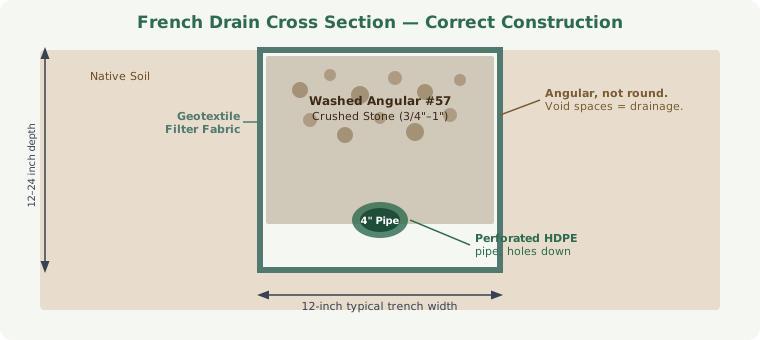
A properly built French drain uses this cross-section from bottom to top:
- Perforated pipe (4-inch HDPE perforated pipe, holes down)
- Crushed stone — 6–12 inches of washed angular #57 or #67 crushed stone surrounding and above the pipe
- Geotextile filter fabric — wraps the entire gravel + pipe assembly to keep soil out (do NOT skip this)
- Optional topsoil or turf — if the drain is buried
The rock volume for a French drain is calculated the same way as surface rock, just with different depth values. For a 50-foot long trench, 12 inches wide, and 12 inches deep (total trench less pipe space):
- Volume = 50 × 1 × 1 = 50 cubic feet = 1.85 cubic yards
- Weight = 50 × 95 lbs/cu ft = 4,750 lbs = 2.38 tons of crushed granite
Calculate the exact rock needed for your French drain trench dimensions.
Foundation Drainage Rock
Around home foundations, drainage gravel does double duty: it moves water away from the foundation wall and prevents soil from pressing directly against the waterproofing membrane.
Best practice:
- 6–12 inches of clean #57 washed crushed stone against the foundation wall
- Wrapped in filter fabric to prevent fine soil infiltration
- Slope grade away from foundation at 1 inch per foot minimum
What fails: using decorative river rock as foundation drainage. It looks appropriate, but its smooth round shape compacts against the foundation wall and soil migrates between the larger gaps.
Dry Well Rock
A dry well is an underground gravel-filled pit that collects concentrated water (from a downspout, for example) and allows it to slowly percolate into surrounding soil.
Size the dry well based on your roof drainage area and local soil permeability. Use #57 crushed stone throughout — the same material as for French drains. A 4×4×4 foot dry well needs approximately 64 cubic feet of gravel minus the space occupied by an optional perforated barrel or form.
How Much Drainage Rock Do You Need?
Use our landscape rock calculator for surface applications. For underground drainage, use the same calculator with your trench or bed dimensions — the cubic feet and tonnage math is identical regardless of whether the rock goes above or below grade.
For most French drain installations, budget 2–3 tons of crushed stone per 50 linear feet of trench (assuming 12-inch wide × 12-inch deep trench). Add 20% extra for settling and variations in trench dimensions.