Crushed Granite vs Pea Gravel: The Complete Comparison
Crushed granite compacts and stays put. Pea gravel is rounder and cheaper. Compare both on cost, stability, drainage, and best uses before choosing.
Quick Answer
Crushed granite outperforms pea gravel on stability and compaction — it locks in place and doesn't roll or spread. Pea gravel is smoother, slightly cheaper, and more comfortable underfoot. For pathways and stable surfaces, crushed granite is the better choice. For pet areas, play surfaces, and accent beds, pea gravel works well.
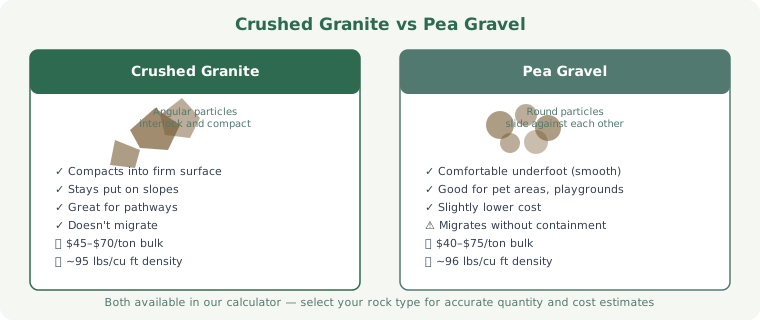
The Core Difference: Shape
This comparison comes down almost entirely to particle shape.
Crushed granite is made by mechanically crushing granite rock. The result is angular particles with rough, broken faces that interlock with each other. When you compact crushed granite — which happens naturally under foot traffic and rain — it creates a firm, semi-solid surface. This is why you see it on park trails, between stepping stones, and in xeriscaped gardens where stability matters.
Pea gravel is naturally rounded by water erosion (or tumbled mechanically). The smooth, round surfaces mean particles slide against each other rather than locking together. Pea gravel doesn't compact into a firm surface — it stays loose and shifting. That's useful in some contexts (cushioning for fall zones, drainage) and a problem in others (slopes, high-traffic paths).
Side-by-Side Comparison
| Property | Crushed Granite | Pea Gravel |
|---|---|---|
| Particle shape | Angular, rough | Round, smooth |
| Compaction | High (firms up) | Low (stays loose) |
| Stability on slopes | Excellent | Poor |
| Comfort underfoot | Moderate | High |
| Drainage rate | Moderate-good | Moderate |
| Cost per ton (bulk) | $45–$70 | $40–$75 |
| Typical size | 1/4–3/4 inch | 1/8–3/8 inch |
| Migration/spreading | Minimal | Significant |
Decomposed Granite: The Third Option
When people search for "crushed granite," they often find two products: crushed granite (what we've described above) and decomposed granite (DG).
Decomposed granite is naturally weathered granite that has broken down into fine sand-like particles. It compacts even more firmly than crushed granite — to the point where it approaches a solid surface when wet and rolled. DG is used for driveways, bocce courts, patios, and natural-look pathways. It's cheaper ($35–$60/ton), but it erodes in rain and needs regular maintenance.
Standard crushed granite (not DG) is what to use for landscape beds and pathways where you want stability without creating what's essentially a gravel path.
Performance on Slopes
If your project involves any grade at all — even a gentle 5% slope — crushed granite holds in place while pea gravel rolls downhill.
This isn't a minor difference. After the first heavy rain on a pea gravel slope, you'll have a flat lower section piled with gravel and a bare upper section. Crushed granite on the same slope would show minimal movement.
For sloped areas, angular rock is always the right choice. Crushed granite, crushed limestone, and basalt all work. Round rocks do not.
Pathways: Which Wins?
For a garden pathway or stepping stone path, crushed granite is the clear winner.
When compacted, it creates a walking surface that doesn't shift underfoot. You don't sink in. You don't track loose stones onto the lawn. It looks intentional and finished.
Pea gravel pathways are more comfortable to walk on barefoot, but they require solid containment edging and frequent raking to maintain shape. They also track inside homes far more readily than crushed granite.
Cost difference is minimal: Both materials run $40–$75/ton. For a typical 20×3 ft pathway at 3 inches deep, you need about 0.39 tons of either material — a cost difference of just $5–$15 depending on local pricing. The stability benefit of crushed granite is worth it.
Garden Beds and Planting Areas
Here, the choice is less clear-cut.
Crushed granite looks natural in drought-tolerant, xeriscape-style plantings. It's particularly popular in the Southwest, where the aesthetic matches succulents, ornamental grasses, and native plants. Its angular texture reflects the natural landscape. It also doesn't migrate from beds into adjacent lawn areas the way pea gravel does.
Pea gravel is a better choice around plants with shallow, spreading root systems because it doesn't compact around roots. It's also easier to move and rake around plants during maintenance. Its smooth, round appearance suits cottage garden styles and more formal planting designs.
Neither is wrong for a planting bed — it's more about aesthetic preference and maintenance style.
Calculating How Much You Need
Both materials are calculated the same way: volume of the area times the rock's bulk density gives you tonnage. Crushed granite is 95 lbs/cu ft; pea gravel is 96 lbs/cu ft. The difference is negligible for calculation purposes — treat them as equal for ordering estimates.
Run your dimensions through our landscape rock calculator and select either "Crushed Granite" or "Pea Gravel" depending on your choice. You'll get tons, cubic yards, and an estimated material cost instantly.
For a 200 sq ft area at 3 inches deep, you'll need roughly 1.44 tons of either material — about $65–$100 at typical bulk pricing.
Bottom Line
Choose crushed granite when stability matters most: sloped areas, pathways, between stepping stones, or any place where you don't want rock migrating.
Choose pea gravel when comfort and drainage are priorities: pet areas, play zones, decorative accent beds, and flat areas where the smooth look suits the garden style.
Still undecided? Read our pea gravel vs river rock comparison for another angle on choosing between rounded and angular landscape stones, or check our 2025 cost guide to compare pricing across all rock types.