Lava Rock Landscaping: Uses, Benefits, and How Much You Need
Lava rock is lightweight, heat-resistant, and ideal for slopes and fire features. Learn the best uses, depth recommendations, and how to calculate your order.
Quick Answer
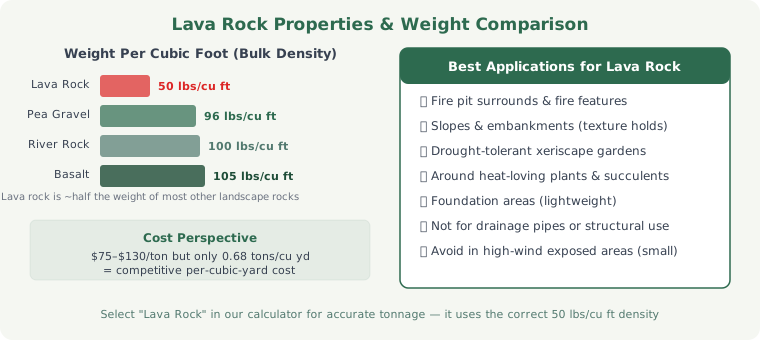
Lava rock is the lightest common landscape rock at ~50 lbs per cubic foot — roughly half the weight of granite or river rock. It's best for slopes (where its rough texture holds it in place), fire pit surrounds, heat-tolerant plantings, and areas where you want a bold visual statement. It costs $75–$130 per ton, and you'll need significantly fewer tons per cubic yard than denser rocks.
What Makes Lava Rock Different
Lava rock — technically called scoria — is formed when molten lava cools rapidly, trapping gas bubbles that create the characteristic porous, Swiss-cheese-like structure. That porosity is why it behaves so differently from other landscape rocks.
Weight: Lava rock's bulk density is approximately 50 lbs per cubic foot — compared to 95–105 lbs/cu ft for granite, limestone, and river rock. This means you get the same visual coverage with far fewer tons. A 200 sq ft bed at 3 inches deep needs only 0.75 tons of lava rock vs. 1.44 tons of pea gravel. Our landscape rock calculator accounts for this density difference when you select Lava Rock.
Drainage: The porous surface allows water to pass through individual stones (not just between them), making it one of the best-draining landscape surfaces. This is ideal for plants that are sensitive to waterlogged roots.
Heat retention: Lava rock's dark color (most commonly deep red or black) absorbs heat during the day and releases it slowly at night. In cold climates, this can extend the growing season slightly. In hot climates, it can stress plants — choose wisely based on your zone.
Where Lava Rock Performs Best
Sloped Areas and Embankments
Lava rock's rough, angular surface texture creates friction between stones that prevents rolling and migration — a major advantage over smooth rocks like river rock and pea gravel. On slopes over 5%, it's one of the few decorative rocks that actually stays where you put it.
If you've struggled with rock washing downhill after every rain, lava rock's porous texture is a significant upgrade.
Fire Pit Surrounds and Fire Features
Lava rock handles high temperatures without cracking or spalling, which is why it's a standard material around fire pits, fire tables, and gas fire features. Dense rocks like river rock and granite can trap moisture internally and crack explosively when rapidly heated — a real safety concern.
Lava rock is sold specifically as a fire pit media in gas fire feature applications, where it distributes the flame more naturally than ceramic logs.
Drought-Tolerant and Xeriscape Gardens
In the American Southwest and other arid regions, lava rock is a traditional landscape material paired with succulents, cacti, yucca, agave, and native grasses. Its natural look complements desert plant palettes, and its porous nature helps plants access water from light rain events.
The heat retention that can stress temperate garden plants is actually beneficial for heat-loving species that need warm root zones.
Foundation and Tree Ring Mulch Applications
Because lava rock doesn't compact the way organic mulch does and doesn't touch bark tissues the way mulch can (bark disease is a concern with mulch piled against trunks), it's sometimes used as a mulch alternative around established trees. The lighter weight also means less compaction pressure on surface roots.
Costs and What to Expect
At $75–$130 per ton, lava rock is mid-range to premium priced. However, because it weighs so much less than other rocks, the cost per cubic yard is more competitive.
Per cubic yard comparison:
- Pea gravel: $55/ton × 1.30 tons/cu yd = $72/cu yd
- Lava rock: $100/ton × 0.68 tons/cu yd = $68/cu yd
The per-cubic-yard cost is actually similar or lower for lava rock, despite the higher price per ton. The lower density is an equalizer.
For full pricing across all rock types, see our 2025 landscape rock cost guide.
How Much Lava Rock Do You Need?
Use our rock quantity estimator and select "Lava Rock" from the dropdown. It uses the correct 50 lbs/cu ft bulk density, so your tonnage estimate will be accurate.
For reference:
- 100 sq ft at 2 inches deep = 0.26 tons of lava rock
- 100 sq ft at 3 inches deep = 0.38 tons of lava rock
- 200 sq ft at 3 inches deep = 0.75 tons of lava rock
Compare this to pea gravel at the same dimensions (1.44 tons for 200 sq ft at 3 inches) — lava rock is nearly half the tonnage for the same coverage.
Common Sizes and How They Look
Lava rock typically comes in three sizes:
Small (3/4–1 inch): Finer texture, looks more like decorative gravel. Good for tight spaces and around small plants. Tends to blow around in high winds.
Medium (1.5–3 inch): The most popular size for general landscaping. Substantial enough to stay in place, fine enough to look intentional in beds.
Large (4–6 inch): Bold, structural look. Best for accents, fire surrounds, or large-scale commercial plantings.
Downsides to Know Before You Order
Color fading: Red lava rock fades toward brown/rust over time with UV exposure. Black lava rock tends to hold its color longer.
Lightweight means wind susceptibility: In open, exposed areas with strong wind, lighter lava rock pieces can migrate. Larger sizes (2+ inch) handle wind better.
Debris accumulation: The porous surface traps leaves, pine needles, and fine debris more readily than smooth rocks. It's harder to blow clean with a leaf blower.
Cost per ton: $75–$130/ton is notably more than pea gravel or limestone. However, the per-cubic-yard cost is more competitive due to low density.
Not for drainage pipes: Lava rock's porous structure can eventually break down under heavy compressive loads. Don't use it as drainage rock in structural applications. See what rock to use for drainage.
Installation Tips
Install lava rock the same way as any landscape rock: clear vegetation, install woven landscape fabric, add containment edging, and spread to your target depth. The lower weight makes it significantly easier to handle — a cubic yard of lava rock weighs only 920 lbs vs 2,600 lbs for granite. You'll move noticeably more material with fewer wheelbarrow loads.
For a full installation walkthrough, see our step-by-step landscape rock installation guide.